professional-work
Agricultural e-commerce — operations and UI permissions
I built the initial admin frontend for an agricultural e-commerce migration and later returned to purchase orders, external order matching and permissions. I separated shared lists from task-specific rules and enabled actions only after permissions were ready and allowed them.
Building a foundation, then returning to operations
The agricultural e-commerce admin was developed to support migration of an existing agricultural e-commerce site. I built the initial React/Vite project, routing and shared UI. After spending more time on the university project, I returned to purchase orders, external order and product-option matching, linked claims and UI permissions.
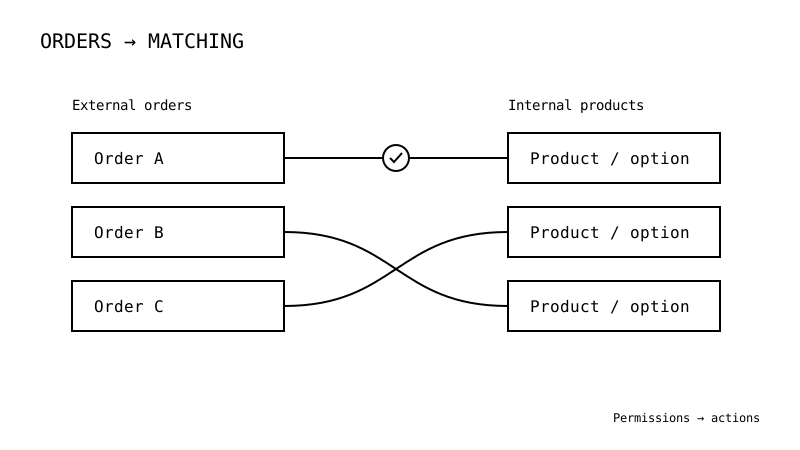
The work on my return was different from setting up the first screens. Orders from external channels needed to map to internal products, and purchase orders and claims had their own states to inspect and change. Similar-looking tables had to express different operational rules.
I applied paginated tables to purchase-order requests and built Excel template linking and download flows. I also connected product-option matching and linked claim statuses and notes to the internal screens.
Considering the screen before permissions arrive
People using the same screen may be allowed to perform different actions. Using the existing permission API, I distinguished loading permission data from receiving explicit allowance. Actions became available only after both conditions were met. Route access was controlled for users entering a URL directly as well.
I later reorganized a global permission map into domain policies and hooks. Shared interface elements remained reusable, while the rules governing each task could be read separately. These UI controls complement server authorization.
The work connected the initial foundation to purchase-order and matching tasks across management screens. My contribution within the team’s admin project was these operational interfaces and frontend controls.
Between shared UI and task-specific rules
The API kept changing as these workflows developed. I automated OpenAPI collection, diffs and reference client generation, then adapted DTOs and Valibot schemas to changed responses and request fields. I clarified ID/date types, nullable values and page/cursor differences so screens interpreted the data consistently.
Purchase-order work extended beyond making a request. I connected holds, document creation, email sending and Excel downloads with confirmation dialogs, error handling and subsequent list updates. Template management also covered sorting, item selection, loading and duplicate-name errors. Lists and selection state could be shared, while each task still needed to make the action being confirmed clear.
In my personal Archon Admin project, custom tables and dropdowns became complex, and authorization remained incomplete. Reading the two now draws my attention to the boundary between reusable interfaces and task-specific policy. It is a question encountered in different settings, rather than an established code lineage.